A Literary Tour of Yorkshire: Beyond the Brontes
Yorkshire has shaped some of the most powerful writing in the English language. The Bronte sisters are rightly celebrated, but the county's literary heritage runs far deeper and wider than Haworth alone. From the atmospheric ruins that inspired Bram Stoker's Dracula to a medieval hall where Laurence Sterne penned one of literature's most eccentric novels, this guide takes you on a tour of the places where great writing took root -- and where you can still feel it in the air today.
Haworth and the Bronte Parsonage Museum
No literary tour of Yorkshire can begin anywhere else. The Bronte Parsonage Museum on Church Street in Haworth was home to the Bronte family from 1820 to 1861, and it was here that Charlotte, Emily, and Anne wrote some of the most enduring novels in the English language: Jane Eyre, Wuthering Heights, and The Tenant of Wildfell Hall.
The museum houses the world's largest and most significant collection of Bronte manuscripts, personal belongings, and artworks. Walking through the small, meticulously preserved rooms, you get a palpable sense of the creative intensity that filled this household. The dining room table where the sisters wrote is still here, as is the sofa where Emily is believed to have died.
Beyond the museum, Haworth itself rewards exploration. The steep cobbled Main Street is lined with independent bookshops and cafes, and the surrounding moorland -- the wild landscape that so profoundly shaped the sisters' imaginations -- is freely accessible on foot. A popular walk heads from the Parsonage through fields and along a flagstone path to the Bronte Waterfall and the ruins of Top Withens, a remote farmhouse sometimes linked to Wuthering Heights (though scholars note it bears little resemblance to Bronte's description).
The museum is open Wednesday to Monday, 10am to 5pm. Allow at least an hour inside, and more if you plan to walk on the moors.
The Keighley and Worth Valley Railway
For a memorable approach to Bronte Country, consider arriving by heritage steam train. The Keighley and Worth Valley Railway runs for five miles from Keighley to Oxenhope, stopping at Haworth along the way. The line was originally proposed in 1861 after a civil engineer visited Haworth to pay tribute to Charlotte Bronte and was surprised to find the village had no railway connection. Closed by British Rail in the 1960s, it was reopened in 1968 by a preservation society and is now run by over 500 volunteers.
The journey through the Worth Valley is a beautiful introduction to the landscape, and Haworth station itself is a charming period piece. The railway also featured as a filming location for The Railway Children (1970), adding another layer of literary connection.
Whitby: Where Dracula Came Ashore
Whitby's connection to Bram Stoker's Dracula is one of Yorkshire's most evocative literary stories. In the summer of 1890, Stoker arrived at Mrs Veazey's guesthouse at 6 Royal Crescent for a holiday. He was working as business manager for the actor Henry Irving, who had recommended the town as a place to rest.
What Stoker found in Whitby gave shape to the novel he had been developing. The dramatic ruins of Whitby Abbey, perched on the East Cliff above the harbour, became one of the book's key settings. The 199 steps leading up to St Mary's Church, the atmospheric graveyard, and the narrow streets of the old town all made their way into the story. Even the name Dracula came from Whitby -- Stoker found it in a book about Wallachia and Moldavia in the town's subscription library.
In the novel, Stoker has the Russian schooner Demeter run aground on Tate Hill Sands, carrying Dracula to England in the form of a large dog. This detail was inspired by the real wreck of a Russian vessel, the Dmitry, which ran aground near Whitby.
Today, Whitby Abbey is managed by English Heritage and is well worth visiting for the ruins themselves, which date from the thirteenth and fourteenth centuries, built on the site of a much earlier Anglo-Saxon monastery founded in 657. The views from the clifftop are spectacular. Down in the town, the Whitby Museum in Pannett Park -- run by the Whitby Literary and Philosophical Society since 1823 -- holds fascinating collections relating to local history, Whitby jet, fossils, and Captain Cook.
Shandy Hall, Coxwold
One of Yorkshire's most delightful literary surprises sits in the quiet village of Coxwold, in the Hambleton Hills of North Yorkshire. Shandy Hall is a medieval hall house, built around 1430, which became the home of the Reverend Laurence Sterne when he was appointed perpetual curate of Coxwold in 1760.
It was here, over the following eight years, that Sterne wrote much of The Life and Opinions of Tristram Shandy, Gentleman -- a wildly inventive, digressive, and frequently hilarious novel that upended every convention of eighteenth-century fiction. He also wrote A Sentimental Journey Through France and Italy at the same desk. Today, Shandy Hall houses the world's largest collection of editions of Sterne's works, centred on the study where he wrote.
The house is a Grade I listed building and has been open to the public since 1973, managed by the Laurence Sterne Trust. The two acres of gardens are lovely in their own right, with over a hundred old varieties of roses and both formal and informal areas managed to encourage wildlife. The Hall is open from May to September, with house tours available at weekends and the gardens open Wednesday to Sunday.
Coxwold is a handsome village well worth lingering in, and a visit to Shandy Hall pairs beautifully with a walk in the surrounding countryside.
York: Layers of Literary History
York's literary connections span more than a millennium. The city can claim Caedmon's Hymn -- composed at Whitby Abbey but closely associated with York's Anglo-Saxon scholarly tradition -- as one of the earliest surviving works of English poetry. Alcuin, the great scholar who advised Charlemagne, was educated at the cathedral school in York in the eighth century.
Fast forward to the twentieth century, and York is the birthplace of W.H. Auden, born on 21 February 1907 at 54 Bootham. Although Auden's family moved to Birmingham during his childhood, the city still claims one of the most influential poets of the modern era as its own.
For book lovers, the streets around the Shambles and Stonegate offer some excellent independent bookshops. York is also home to the York Literature Festival, which brings authors, poets, and readers together each spring.
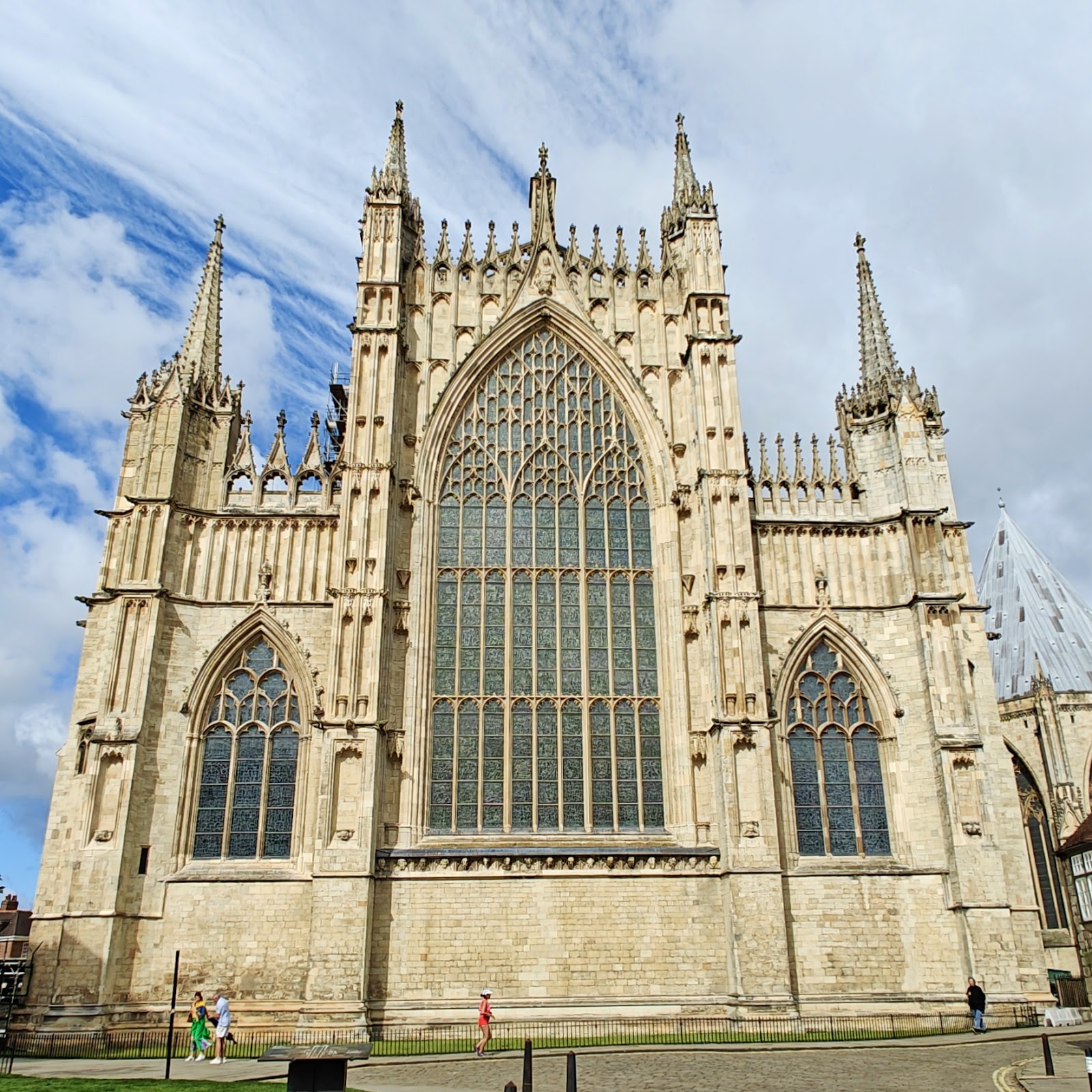
York Minster itself, while primarily a religious and architectural destination, has its own literary resonance. Its Great East Window, completed by the glazier John Thornton between 1405 and 1408, depicts scenes from the Book of Revelation across more than 300 stained glass panels -- the largest expanse of medieval stained glass in Britain. The window is essentially a visual narrative of extraordinary ambition and craftsmanship.
Bradford and the Hockney Connection
Bradford may not spring to mind as a literary destination, but it has a strong claim to artistic heritage through David Hockney, who was born in the city in 1937. While Hockney is primarily a visual artist, his influence on how Yorkshire's landscape is perceived and represented -- through paintings, photography, and iPad drawings -- has a narrative quality that resonates with the county's literary traditions of landscape writing.
The 1853 Gallery at Salts Mill in nearby Saltaire holds one of the largest permanent collections of Hockney's work. Saltaire itself, a UNESCO World Heritage Site built by the industrialist Sir Titus Salt to house his mill workers, tells a powerful story about Victorian philanthropy and the relationship between industry and community.
Bradford also hosts the Bradford Literature Festival, one of the UK's most diverse literary festivals, which has grown significantly since its founding in 2014 and regularly features major international authors alongside local voices.
Planning Your Literary Yorkshire Trip
A thorough literary tour of Yorkshire requires at least a long weekend, and ideally more. Here's one possible itinerary:
Day One: Bronte Country. Take the Keighley and Worth Valley Railway to Haworth. Visit the Bronte Parsonage Museum, explore the village, and walk out onto the moors if weather permits.
Day Two: The Coast. Drive or take the bus to Whitby. Climb the 199 steps to the Abbey, visit the museum in Pannett Park, and walk along the harbour where Stoker found his inspiration.
Day Three: York and Beyond. Spend a morning in York exploring its bookshops and the Minster. In the afternoon, drive out to Coxwold to visit Shandy Hall (seasonal opening -- check the website before you go).
All these destinations are accessible by public transport, though a car gives you more flexibility, particularly for Coxwold and the remoter parts of Bronte Country. The Bronte Parsonage Museum and Whitby Abbey both get busy during school holidays, so early arrivals are recommended.
Yorkshire's literary landscape is as varied as its physical one -- wild moors, gothic clifftops, quiet villages, and bustling cities all played their part in shaping some of the finest writing in the English language. The best way to understand that writing is to visit the places where it was born.
Sources & Useful Links
- Bronte Parsonage Museum — The Bronte family home in Haworth with the world's largest collection of Bronte manuscripts
- Keighley & Worth Valley Railway — Heritage steam railway running from Keighley to Oxenhope through Bronte Country
- Whitby Abbey, English Heritage — Atmospheric clifftop ruins that inspired Bram Stoker's Dracula
- Whitby Museum — Local history, Whitby jet and fossils in Pannett Park, run since 1823
- Shandy Hall, The Laurence Sterne Trust — Coxwold home where Sterne wrote Tristram Shandy, open May to September
- York Minster — The largest Gothic cathedral in England, with medieval stained glass
- Visit York — Official tourism guide for the city of York
- Bradford Literature Festival — One of the UK's most diverse literary festivals, held annually in July
- Salts Mill, Saltaire — The 1853 Gallery with David Hockney's work in a UNESCO World Heritage village
- Welcome to Yorkshire — Regional tourism information and visitor guides