Yorkshire is a county that seems purpose-built for walking. Two national parks, a dramatic coastline, and a patchwork of moorland, dale and ancient woodland conspire to produce some of the most rewarding outdoor experiences anywhere in England. Whether you prefer a gentle riverside stroll or a gruelling fell-top challenge, there is something here that will get your boots muddy and your spirits soaring.
What follows is a thoroughly researched guide to ten of Yorkshire's finest outdoor destinations, from iconic peaks to hidden nature reserves, each one verified and genuinely worth the journey.
The Yorkshire Three Peaks
No guide to Yorkshire's outdoors would be complete without the Three Peaks Challenge. This legendary 24-mile (38.6 km) circular route takes in the three highest summits in the Yorkshire Dales: Pen-y-ghent (694 m), Whernside (736 m) and Ingleborough (723 m). The traditional starting point is the village of Horton-in-Ribblesdale, where walkers traditionally began their attempt. The famous Pen-y-ghent Cafe, which once operated the traditional clocking-in system for Three Peaks walkers, closed in 2018, but the challenge remains as popular as ever.
The challenge is typically walked anti-clockwise, tackling Pen-y-ghent first, then Whernside, and finishing with Ingleborough, with a target completion time of under 12 hours. The total ascent of 1,585 metres is no small undertaking, and the route should not be attempted without proper equipment, navigation skills, and a realistic assessment of your fitness, but each summit rewards with panoramic views across the Pennines. You do not have to attempt all three in a single day, of course. Each peak makes an excellent standalone walk, with Pen-y-ghent being the most straightforward at around approximately 6.3 miles from Horton-in-Ribblesdale and back.
An OS Explorer OL2 map is essential for navigation, and conditions on the tops can change rapidly even in summer.
Malham Cove and Gordale Scar
The Malham area delivers some of the most visually striking geology in Britain. Malham Cove is a curving amphitheatre of limestone cliff, roughly 80 metres high, formed by a waterfall carrying glacial meltwater over 12,000 years ago. The climb to the top reveals an extraordinary limestone pavement, its clints and grykes sculpted by millennia of rainfall. Sharp-eyed visitors may recognise it from the Harry Potter films.
A mile to the east, Gordale Scar is a deep limestone ravine with overhanging walls and a thundering waterfall. The artist James Ward painted it on a canvas over three metres wide in 1814, and it is no less dramatic in person. The scramble up beside the lower waterfall is manageable for reasonably fit walkers in dry conditions, though the rock becomes dangerously slippery after rain and the route should not be attempted in wet weather.
A popular circular walk from Malham village takes in both formations along with Janet's Foss, a charming woodland waterfall, covering around 7.5 miles. The route is well-signposted and ranks among the most popular in the entire Dales.
Ingleton Waterfalls Trail
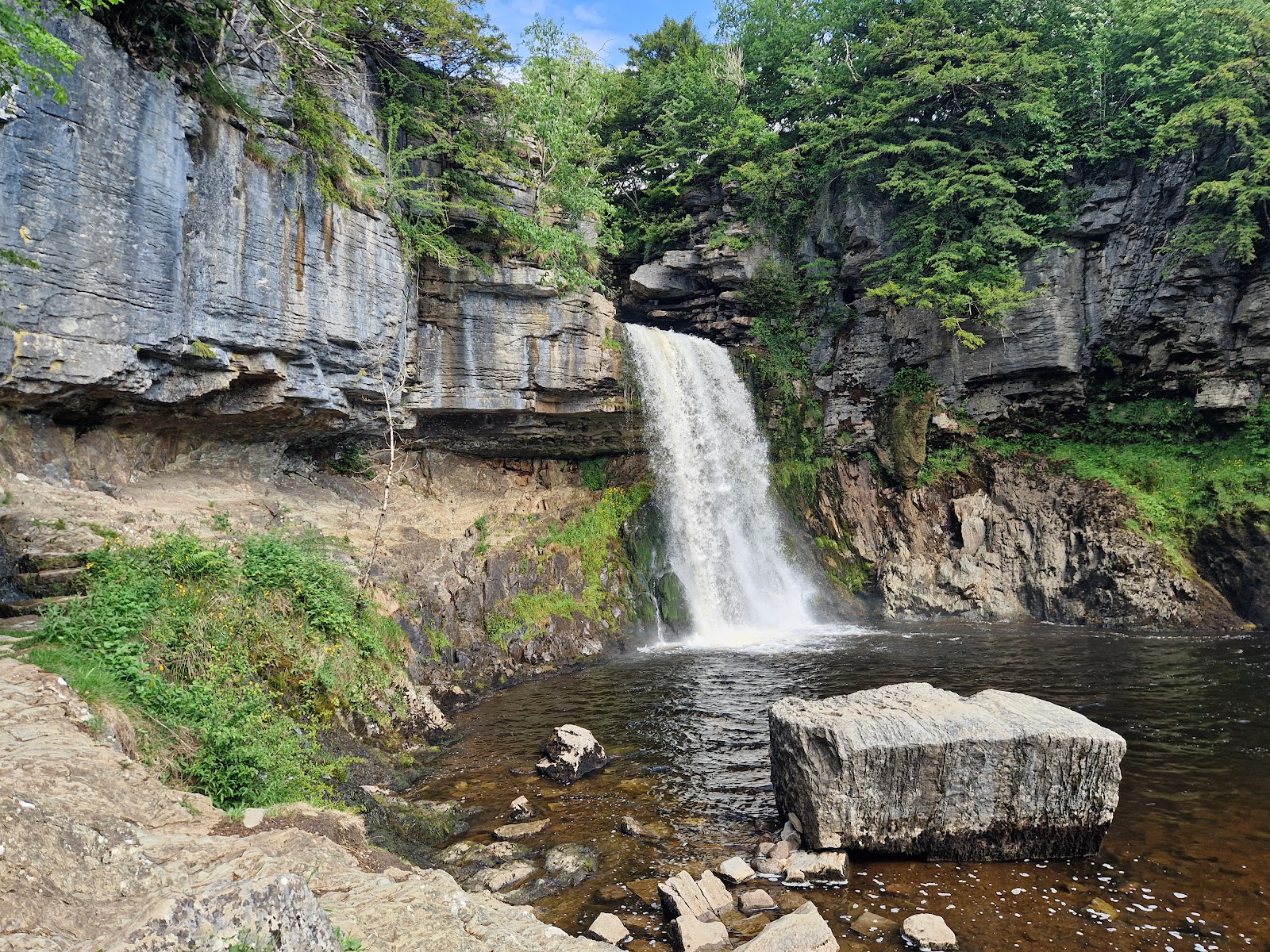
This 4.3-mile (7 km) circular trail through the glens of the River Twiss and River Doe is one of Yorkshire's most celebrated waterfall walks. The trail passes six named waterfalls, including Thornton Force, where water plunges over a ledge of ancient rock, and Beezley Falls, a long cascade through dense woodland.
The path is well-maintained with boardwalks and steps, making it accessible to families with older children, though the 169 metres of vertical ascent across the route means it is not entirely flat. The trail starts and finishes in the village of Ingleton, and there is a modest entrance fee that funds path upkeep. Allow around two to three hours, and budget extra time for lingering at the falls.
Aysgarth Falls
Set in Wensleydale, Aysgarth Falls is a series of three broad cascading waterfalls where the River Ure tumbles over wide limestone shelves. The Upper, Middle and Lower Falls each have a distinct character, and the surrounding ancient woodland is particularly beautiful in autumn.
The Yorkshire Dales National Park Visitor Centre at Aysgarth is a useful starting point, with a cafe, shop and information about local walks. From the centre, well-marked paths lead to all three falls within a gentle one-mile stroll. For a longer outing, a circular walk to the nearby village of West Burton and its own picturesque waterfall extends the route to around 6 miles.
The falls featured in the film Robin Hood: Prince of Thieves, though purists may note that Wensleydale is a long way from Sherwood Forest.
Whitby to Robin Hood's Bay Coastal Walk
This section of the Cleveland Way National Trail is widely regarded as one of the finest coastal walks in England. The route runs for approximately 6 to 7 miles along dramatic cliff tops between the historic port of Whitby and the impossibly picturesque fishing village of Robin Hood's Bay.
The walk begins near Whitby Abbey, where a Cleveland Way marker post points the way south. The first stretch passes Saltwick Bay, a popular spot for fossil hunting where ammonites can be found embedded in the rocks. From there, the path follows the cliff edge through open farmland, with sweeping views of the North Sea and the coastline stretching ahead.
Robin Hood's Bay itself is a tumble of red-roofed cottages clinging to a steep ravine, with a tiny beach at the bottom. The village was once a notorious smuggling haunt, and the narrow alleys and hidden passageways give it a genuine sense of history.
For the return journey, you can retrace your steps, follow the old railway cinder track inland (a flatter, easier alternative), or simply catch the hourly bus back to Whitby.
Flamborough Head and the Chalk Cliffs
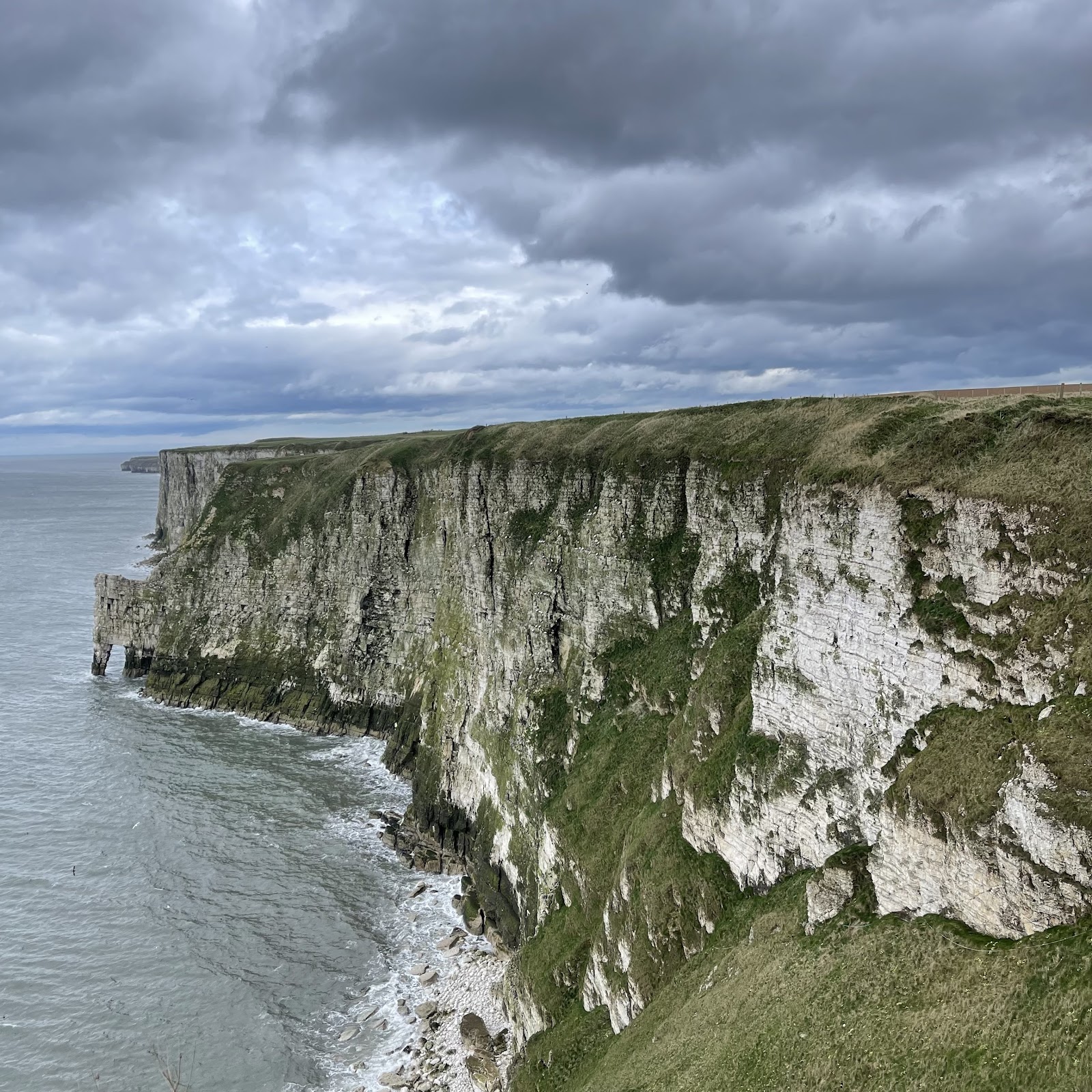
Flamborough Head juts out into the North Sea on the East Yorkshire coast, and its towering white chalk cliffs are unlike anything else in the county. The Flamborough Cliffs Nature Reserve, managed by Yorkshire Wildlife Trust, protects a stretch of coastline that hosts an estimated 200,000 nesting seabirds during the breeding season.
A 7-mile circular walk from Flamborough village takes in the lighthouse, the dramatic sea stacks at Thornwick Bay, and the sheltered cove at North Landing. Between March and July, the cliffs are alive with gannets, guillemots, razorbills, kittiwakes and, most famously, puffins. This is the most southerly puffin nesting site on the British mainland.
The King Charles III England Coast Path runs through the reserve, and there are car parks at both North Landing and Thornwick Bay.
Bempton Cliffs RSPB Reserve
Just along the coast from Flamborough, Bempton Cliffs is the RSPB's flagship seabird reserve in England. The chalk cliffs here rise to over 100 metres, and between April and August they are home to the only mainland gannetry in England, with over around 15,000 pairs of gannets alone.
Six cliff-top viewing platforms provide safe vantage points to watch the spectacle at remarkably close range. The visitor centre has telescopes, a cafe and a shop, and RSPB volunteers are on hand to help identify species. In addition to gannets, you can expect to see puffins, guillemots, razorbills and fulmars.
The reserve is a 10-minute drive from Bridlington and easily combined with a visit to Flamborough Head for a full day of coastal wildlife watching.
The Bridestones, Dalby Forest
Tucked away on Staindale Moor within Dalby Forest on the southern edge of the North York Moors, the Bridestones are a collection of extraordinary sandstone rock formations sculpted by wind and rain over millions of years. Managed by the National Trust, the reserve is a mosaic of heather moorland, ancient woodland and wetland.
A waymarked trail from the Low Staindale car park on the Dalby Forest Drive leads through the reserve, passing the most impressive formations, some of which balance improbably on narrow pedestals. The walk is around 2 miles and suitable for families, though the terrain is uneven in places.
Dalby Forest itself offers miles of additional walking and cycling trails, and is one of the best locations in England for stargazing, having been designated a Dark Sky Discovery Site.
The Cleveland Way
The Cleveland Way National Trail is a 109-mile horseshoe-shaped route that traces the western and northern edges of the North York Moors before following the coast south to Filey. It was one of the first long-distance paths to be designated in England, opening in 1969.
Walkers who do not fancy the full multi-day trek can dip into individual sections. The inland stretch over the Hambleton Hills and Cleveland Hills offers sweeping moorland views and dramatic outcrops such as the Wainstones, a cluster of rocky pinnacles on Hasty Bank. The coastal section, from Saltburn to Filey, is consistently spectacular, passing through Staithes, Whitby and Robin Hood's Bay.
The Hole of Horcum, a vast natural amphitheatre near the A169 between Pickering and Whitby, is one of the most photographed features along the inland route. Despite local legend attributing it to a giant scooping out earth, it was formed by natural erosion of the soft moorland rock.
Practical Tips for Walking in Yorkshire
Yorkshire's weather is famously unpredictable, particularly on higher ground. Even in summer, conditions on the Three Peaks or the Cleveland Way can change within minutes, so waterproofs and warm layers are essential at any time of year.
The Yorkshire Dales and North York Moors national parks both maintain excellent websites with downloadable route guides, condition updates and safety advice. Ordnance Survey maps remain the gold standard for navigation, and the OS Explorer OL2 (Yorkshire Dales Southern and Western), OL30 (Yorkshire Dales Northern and Central) and OL26/OL27 (North York Moors) cover most of the walks described here.
Public transport access varies. Horton-in-Ribblesdale and Whitby are served by rail, and many coastal villages have regular bus services, particularly in summer. The Moorsbus network runs seasonal services to otherwise hard-to-reach spots in the North York Moors.
Finally, respect the countryside. Stick to paths, close gates, keep dogs under control, and take your litter home. These landscapes are as beautiful as they are because generations of walkers and farmers have looked after them.
Sources & Useful Links
- Yorkshire Dales National Park - Walking - Official walking guides, route downloads and condition updates for the Dales
- North York Moors National Park - Walking - Route guides and visitor information for the North York Moors
- Yorkshire Three Peaks Challenge - Official Route - Detailed route information, maps and GPX downloads
- Cleveland Way National Trail - Official trail guide for the 109-mile Cleveland Way
- RSPB Bempton Cliffs - Visitor information, opening times and wildlife updates
- Flamborough Cliffs Nature Reserve - Yorkshire Wildlife Trust - Reserve details and visiting information
- Ingleton Waterfalls Trail - Trail information, opening times and directions