The Shape of the Day
This day trip connects two of the Yorkshire Dales' finest attractions with a journey of just six miles between them, giving you a rare combination: a morning in a properly historic market town, followed by an afternoon walking through some of the most beautiful riverside scenery in northern England. Skipton and Bolton Abbey sit at the southern edge of the Dales, making them easily accessible from Leeds (about 45 minutes), Bradford (40 minutes), Harrogate (35 minutes) or York (just over an hour).
The beauty of this particular pairing is that neither destination needs to be rushed. Skipton rewards a leisurely morning of castle-exploring, canal-watching and market-browsing, while Bolton Abbey and Strid Wood deserve a proper afternoon's walking. Together, they make a genuinely varied day that balances culture, food and fresh air.
Skipton Castle: Nine Hundred Years of History
Start your day at Skipton Castle, which stands at the top of the High Street and has watched over this market town for more than nine centuries. The castle was originally built in 1090 by Robert de Romille, a Breton nobleman who arrived in England with William the Conqueror. What began as a timber motte-and-bailey fortification was gradually rebuilt in stone, particularly after Robert de Clifford acquired the castle in 1310 and began major fortification works.
The castle's most remarkable chapter came during the English Civil War, when it was the last Royalist stronghold in the north of England to surrender, holding out until December 1645 after a three-year siege. The damage was extensive, but the formidable Lady Anne Clifford — one of the great figures of seventeenth-century English history — undertook a comprehensive restoration that gives Skipton Castle the completeness that distinguishes it from so many other medieval castles. You can still see the yew tree she planted in the central courtyard to mark the completion of her restoration work.
The self-guided tour takes you through the banqueting hall, the kitchen with its massive fireplace, the bedchamber, and the watchtower with views across to the moors. The castle is one of the most complete medieval castles in England, with a full roof and much of its interior intact — a rarity that allows you to understand how these spaces were actually lived in, rather than imagining them from roofless shells.
Allow about an hour for the castle. It is open daily (closed 23–25 December).
The High Street and Skipton Market
Emerging from the castle, you step directly onto Skipton's broad High Street, which has been the commercial heart of the town since the Middle Ages. The street is unusually wide — originally designed to accommodate the medieval cattle market — and today it hosts one of Yorkshire's best traditional markets on Mondays, Wednesdays, Fridays and Saturdays.
Market days transform the High Street with stalls running down both sides, selling everything from local cheese and fresh bread to clothing and handmade crafts. Each day has a slightly different character and a rotating cast of traders, so no two visits are quite the same. Even on non-market days, the High Street rewards exploration. Skipton has maintained a strong independent retail character, with butchers, bakers, outdoor shops and bookshops holding their ground alongside the usual high street names.
Halfway down the High Street, duck through one of the narrow ginnels (alleyways) on the southern side and you'll find yourself on the towpath of the Leeds and Liverpool Canal. This 127-mile waterway — the longest canal built as a single enterprise in Britain — passes right through the centre of Skipton, and the stretch beside the town is one of its most attractive sections. Narrowboats line the banks, ducks patrol the water, and the pace drops noticeably from the bustle of the High Street above.
A Canal Boat Trip
For a different perspective on Skipton and the surrounding countryside, consider a short canal boat trip. Pennine Cruisers, based on Coach Street beside the canal basin, offer 30-minute trips that run throughout the day. Longer options include guided cruises with refreshments served on board. The canal threads through the Skipton countryside towards the Dales, passing beneath stone bridges and through farmland that feels remarkably rural given how close you are to town.
Boat trips run from spring through to autumn, with the 30-minute options available from 10.30am most days during the season.
Lunch in Skipton
Skipton punches well above its weight for food. For fish and chips — and this being Yorkshire, quality matters — Bizzie Lizzie's on Swadford Street has been a local institution for decades. The Swadford Street branch overlooks the canal, and their fish is coated in crispy batter and served with chips fried in beef dripping, which is the traditional Yorkshire way. They also cater well for dietary requirements, with a dedicated fryer for gluten-free options.
Alternatively, the pubs along the canal serve hearty lunches, and the market stalls offer excellent grab-and-go options if you'd rather eat on the move. Stock up here if you want picnic supplies for Bolton Abbey — there are several good delis and bakeries on and around the High Street.
Before leaving Skipton, it is worth popping into the Craven Museum inside the Town Hall on the High Street. This free museum houses a collection of over 60,000 objects telling the story of Craven — the historic district that encompasses Skipton and the surrounding Dales. The building itself, constructed in 1862, has been beautifully refurbished and also houses a gallery with rotating exhibitions.
The Drive to Bolton Abbey
The six-mile drive from Skipton to Bolton Abbey follows the B6160 along Upper Wharfedale, and the scenery improves with every mile. The road follows the River Wharfe as the valley narrows and the Dales landscape asserts itself — limestone walls climbing the hillsides, sheep-dotted fields, and the characteristic barns that punctuate the Yorkshire Dales.
Park at one of the Bolton Abbey Estate car parks. The Cavendish Pavilion car park is well positioned for the riverside walk described below.
Bolton Priory: Ruin and Worship Side by Side
Bolton Abbey is technically a misnomer — the correct name is Bolton Priory, since it was an Augustinian foundation led by a prior rather than an abbot. The priory was established here in 1154, when a community of Augustinian canons moved from their original site at Embsay, five miles to the west. Lady Alice de Romille of Skipton Castle — connecting us back to the morning's visit — granted them the land beside the Wharfe.
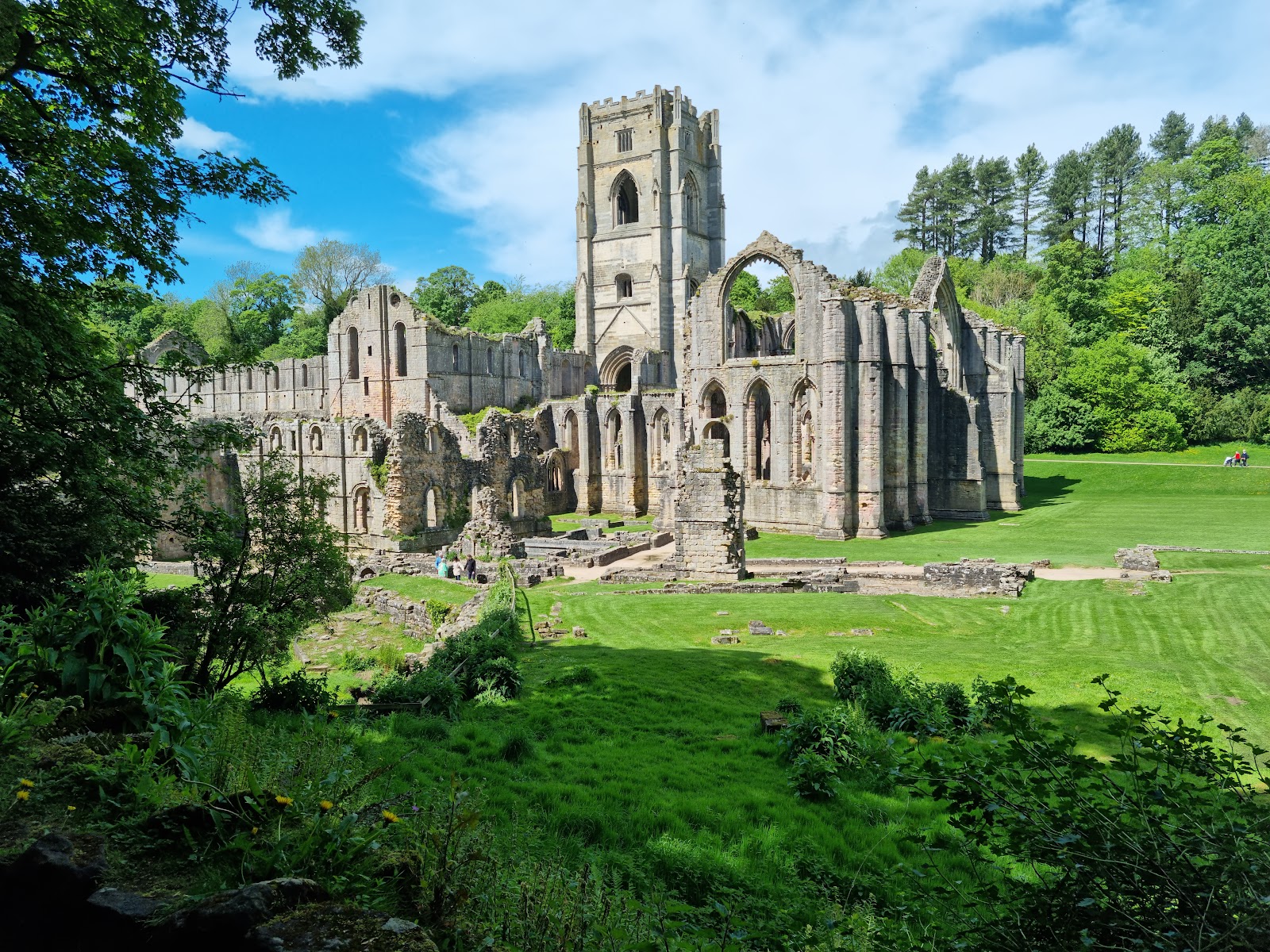
The priory ruins are genuinely beautiful, set on a broad green beside the river with the moorland rising behind. The roofless nave and the great east window create the kind of romantic silhouette that inspired generations of artists — J.M.W. Turner painted the scene, as did Thomas Girtin and Edwin Landseer. What makes Bolton Priory unusual is that the western end of the nave was preserved at the Dissolution and has continued in use as the local parish church ever since. There has been continuous worship on this site since 1154, and Sunday services still take place in the surviving nave.
The priory is free to visit (you pay for estate car parking), and you can explore the ruins at your own pace. The setting beside the river, with stepping stones crossing the Wharfe when water levels allow, is as lovely as any abbey ruin in England.
The Walk Through Strid Wood
From the priory, a well-maintained footpath follows the east bank of the Wharfe upstream through Strid Wood — one of the largest surviving areas of ancient sessile oak woodland in the Yorkshire Dales. The woodland has been designated a Site of Special Scientific Interest, and walking through it is a genuinely immersive experience. Bluebells carpet the forest floor in late April and May, followed by wild garlic. Roe deer, kingfishers and great spotted woodpeckers are all present, and the sound of the river accompanies you throughout.
After about a mile and a half, you reach The Strid — one of Yorkshire's most famous and most dangerous natural features. Here, the River Wharfe suddenly narrows from a wide, gentle flow into a turbulent channel barely a few feet across, forcing the entire volume of the river through a gap in the rocks with tremendous power. The name comes from the Old English word for turmoil, and it is entirely apt. The rocks are deeply undercut and the currents beneath the surface are lethal — heed the warning signs and stay well back from the edge. The Strid is dramatic and fascinating to observe from a safe distance, but it demands respect.
The path continues upstream past The Strid to Barden Bridge, where you can cross the river and return along the western bank for a satisfying circular walk of roughly six miles in total. The terrain is mostly level and the paths are well maintained, though sections can be muddy after rain. Allow two and a half to three hours for the full loop at a comfortable pace.
For a shorter walk, simply follow the riverside path from the priory to The Strid and retrace your steps — around three miles return, taking roughly ninety minutes.
Refreshments at the Cavendish Pavilion
Back near the priory, the Cavendish Pavilion provides welcome refreshments after your walk. Originally built in 1898 to serve the thousands of visitors who arrived by train, this riverside cafe serves sandwiches, hot food, cakes and Yorkshire Dales ice cream. There is seating both inside and on the terrace overlooking the river, making it an ideal spot to rest tired legs and reflect on the afternoon's walking. The pavilion is open daily from 10am to 5pm.
For something more substantial, The Devonshire Arms hotel sits at the entrance to the Bolton Abbey Estate. This seventeenth-century coaching inn, owned by the Duke and Duchess of Devonshire, houses a brasserie serving seasonal food in a relaxed setting, with a terrace overlooking the estate.
Practical Planning
Getting there: Skipton is well served by rail — direct trains run from Leeds (approximately 40 minutes) and there are connections from Bradford, York and beyond. If arriving by car, the town has several pay-and-display car parks. Bolton Abbey is a short drive from Skipton along the B6160; the estate postcode for sat-nav is BD23 6EX.
Timing: Arrive in Skipton by mid-morning to allow time for the castle, market and canal before lunch. Drive to Bolton Abbey early afternoon, leaving yourself three hours for the priory and Strid Wood walk before the estate car parks close.
Cost: Skipton Castle charges admission for the self-guided tour. The Craven Museum is free. Bolton Abbey Estate charges for car parking; the priory ruins are then free to explore. Canal boat trip prices vary by duration.
Footwear: Comfortable walking shoes are fine for Skipton. For the Strid Wood walk, waterproof boots are advisable, particularly in autumn and winter when paths can be muddy.
Market days: Skipton Market runs on Mondays, Wednesdays, Fridays and Saturdays, generally from 9am to 4.30pm. Planning your visit for a market day adds significantly to the experience.
Dogs: Well-behaved dogs on leads are welcome at Bolton Abbey Estate and in Strid Wood.
Two Places, One Story
What connects Skipton and Bolton Abbey is more than just geography. Lady Alice de Romille, who gave the canons their land at Bolton, was from the same Norman family that built Skipton Castle. The Clifford family who later held the castle also had deep connections with the priory. Walking between these two places, you trace a thread of Yorkshire history that stretches from the Norman Conquest through the medieval wool trade to the Dissolution and beyond.
But you do not need to know any of that history to enjoy this day trip. Skipton is simply a cracking market town with a genuinely impressive castle, and Bolton Abbey offers one of the finest riverside walks in England. Together, they make a day that feels complete — varied, unhurried, and satisfying in equal measure.
Sources & Useful Links
- Skipton Castle — Official website for one of England's most complete medieval castles, with visitor info and tour details
- Bolton Abbey Estate — Official estate website covering Bolton Priory, Strid Wood walks, and the Cavendish Pavilion
- Pennine Cruisers — Canal boat trips and day hire on the Leeds & Liverpool Canal from Skipton
- Craven Museum & Gallery — Free museum in Skipton Town Hall with over 60,000 objects of local history
- Welcome to Skipton — Local visitor guide for Skipton market town, including market days and events
- Yorkshire Dales National Park — Official national park site with walking routes, visitor information, and area guides
- The Devonshire Arms — Historic coaching inn and hotel at the Bolton Abbey Estate entrance
- Yorkshire.com — Regional tourism information from Welcome to Yorkshire