Yorkshire has a habit of exceeding expectations. Visitors arrive expecting rolling green hills and perhaps a decent Sunday roast, and they leave having walked across the top of a 80-metre limestone cliff, climbed 199 weathered stone steps to a Gothic abbey ruin overlooking the North Sea, and stood inside one of the largest medieval cathedrals in England. This is a county that does things on a grand scale.
Whether you have a single afternoon or an entire week, Yorkshire rewards the curious traveller with an almost absurd density of world-class attractions, walking routes, and landscapes that have inspired writers, artists, and explorers for centuries. Here is a guide to some of the finest things to do across the county.
York: Two Thousand Years of History in a Single Walk
Any exploration of Yorkshire ought to begin in its ancient capital. York is one of those rare cities where you can trace the full sweep of English history simply by walking its streets. The Romans founded it as Eboracum, the Vikings knew it as Jorvik, and the Normans built the castle mound that still rises above the River Ouse.
The centrepiece is York Minster, the largest Gothic cathedral in England. Construction began in 1220 and continued for over 250 years, producing an interior of staggering beauty. The Great East Window, completed around 1408, is the largest expanse of medieval stained glass in Britain. Visitors can climb the 275 steps of the Central Tower for panoramic views across the city and beyond to the North York Moors.
From the Minster, it is a short stroll to The Shambles, one of the best-preserved medieval streets in Europe. The timber-framed buildings lean inward so dramatically that you could almost shake hands across the upper storeys. Originally a street of butchers' shops -- the name derives from the Anglo-Saxon word "shamel" meaning shelves for displaying meat -- it now houses independent boutiques and cafes.
York's city walls offer another perspective entirely. Around 2.1 miles of medieval masonry survive, forming one of the most complete circuits of any English city. Walking the full circuit takes around two hours and provides elevated views of the Minster, the River Ouse, and the surprisingly green spaces tucked behind the walls. The stretch between Bootham Bar and Monk Bar is particularly rewarding.
The Yorkshire Dales: Limestone, Waterfalls, and Open Skies
The Yorkshire Dales National Park covers over 2,000 square kilometres of some of the most distinctive landscape in Britain. This is a place shaped by geology -- great pavements of limestone scored by glacial meltwater, underground river systems, and dramatic cliff faces that seem to erupt from the valley floors.
Malham Cove is perhaps the most spectacular example. This curved limestone cliff stands over 80 metres high and stretches roughly 300 metres across, formed at the end of the last Ice Age when a waterfall of meltwater carved out the rock face. Today, the waterfall has long since dried up, but the cliff remains utterly magnificent. At the top, a vast limestone pavement extends outward, its flat limestone blocks ("clints") separated by deep fissures ("grikes") creating an otherworldly surface that featured as a filming location in Harry Potter and the Deathly Hallows. The walk from Malham village to the top of the Cove is roughly one mile and suitable for most fitness levels, though the final steps up are steep.
For a more challenging outing, the Ingleton Waterfalls Trail is a 4.5-mile circular route that passes through two wooded river valleys and alongside a series of spectacular waterfalls. The path is well-maintained but includes some steep sections and uneven ground. Highlights include Thornton Force, where the River Twiss plunges over a limestone ledge, and Beezley Falls, a dramatic cascade set in ancient woodland. The trail has been open to walkers since 1885, making it one of the oldest visitor attractions in the Dales.
Fountains Abbey and Studley Royal: A UNESCO World Heritage Site
Tucked into the valley of the River Skell near Ripon, Fountains Abbey is the largest monastic ruin in England. Founded in 1132 by a group of Benedictine monks seeking a stricter way of life, it became one of the wealthiest Cistercian monasteries in the country before Henry VIII dissolved it in 1539.
What survives is remarkably intact. The nave of the abbey church still stands to its full height, its rows of pointed arches framing views of the sky. The cellarium -- a vast vaulted undercroft where the monks stored their provisions -- is one of the most atmospheric spaces in English architecture.
The abbey sits within Studley Royal Water Garden, an 18th-century landscape garden of extraordinary beauty. Classical temples, ornamental ponds, and carefully framed views of the abbey ruins create a landscape that feels both wild and meticulously composed. The entire estate was designated a UNESCO World Heritage Site in 1986 -- Yorkshire's first. It is managed by the National Trust, and a full visit easily fills half a day.
Whitby: Gothic Drama on the North Sea Coast
Whitby is a town that seems to attract stories. Captain Cook served his seamanship apprenticeship here, and his ship HMS Endeavour was built in the town's shipyard. Bram Stoker visited in 1890 and was so struck by the atmosphere that he set key scenes of Dracula here, with the vampire arriving by ship during a storm and bounding up the 199 steps to the clifftop churchyard.
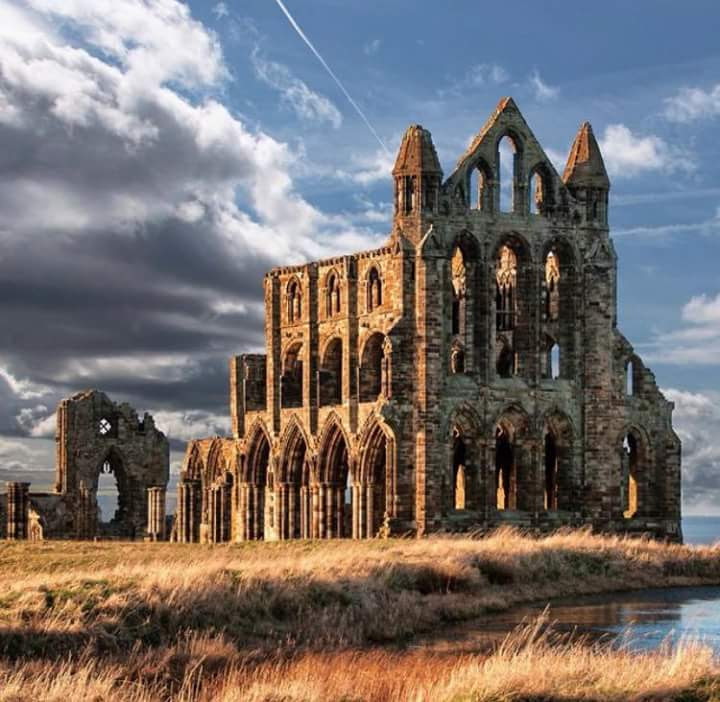
Those 199 steps are still the main route to Whitby Abbey, whose striking Gothic ruins stand high on the East Cliff above the harbour. Originally founded in 657 AD, the abbey was destroyed by Viking raids and later rebuilt by the Normans. The surviving 13th-century remains are managed by English Heritage and offer commanding views along the coast.
Down at harbour level, the town divides neatly into two halves connected by a swing bridge over the River Esk. The old town, clustered beneath the abbey, is a tangle of narrow streets, jet jewellery workshops, and excellent fish and chip shops. The west side is more Victorian in character, with grand terraces looking out towards the twin piers that shelter the harbour mouth.
Brimham Rocks: Nature's Sculpture Gallery
On Brimham Moor, above Nidderdale, stands one of Yorkshire's most curious natural attractions. Brimham Rocks is a collection of fantastically shaped rock formations, carved over 320 million years by water, ice, and wind. Some of the formations are truly bizarre -- balanced boulders that seem to defy gravity, towering pillars, and formations that visitors have named the Dancing Bear, the Sphinx, and the Idol.
The site covers around 50 acres and is managed by the National Trust. It is a superb place for families, with plenty of space for children to scramble and explore (though sensible footwear is essential). The views from the higher points extend across Nidderdale and towards the distant peaks of the Dales.
Castle Howard: Baroque Grandeur in the Howardian Hills
Few English country houses can match the theatrical ambition of Castle Howard, set in a thousand acres of parkland in the Howardian Hills, roughly 15 miles north of York. Designed by Sir John Vanbrugh and Nicholas Hawksmoor at the turn of the 18th century, it is a masterpiece of English Baroque architecture, with a magnificent domed Great Hall, long galleries lined with Old Master paintings, and formal gardens that descend through terraces to a great lake.
The grounds are as rewarding as the house. The Temple of the Four Winds, designed by Vanbrugh in 1724, and the Mausoleum, designed by Hawksmoor, are architectural set-pieces placed at key points across the landscape. The walled garden and the woodland walks provide quieter diversions. Castle Howard will be familiar to many from its starring role as Brideshead in the 1981 television adaptation of Evelyn Waugh's novel.
Yorkshire Sculpture Park: Art in the Open Air
For something more contemporary, Yorkshire Sculpture Park near Wakefield is one of the leading open-air galleries in Europe. Spread across 500 acres of 18th-century parkland, it displays monumental works by artists including Henry Moore, Barbara Hepworth, and Ai Weiwei alongside a changing programme of temporary exhibitions.
The experience of encountering large-scale sculpture in a landscape setting -- framed by rolling hills, ancient trees, and grazing deer -- is quite unlike visiting a conventional gallery. The indoor galleries host ambitious exhibitions, and the park's walking routes connect the scattered artworks across the estate. General admission is now charged, though the outdoor sculptures in the grounds can be glimpsed from public footpaths. Indoor exhibitions may carry an additional charge.
Rievaulx Abbey: A Quieter Masterpiece
Whilst Fountains Abbey draws the larger crowds, many regular visitors to Yorkshire consider Rievaulx Abbey the more beautiful of the two great Cistercian ruins. Nestled in a steep-sided valley near Helmsley, it was the first Cistercian monastery in the north of England, founded in 1132. At its peak, over 140 monks and 500 lay brothers lived and worked here.
The surviving ruins are hauntingly beautiful, particularly the soaring arches of the 13th-century choir. The setting, deep in the wooded valley of the River Rye, adds enormously to the atmosphere. Rievaulx is managed by English Heritage, and the adjacent Rievaulx Terrace (National Trust) provides elevated views down into the abbey from a landscaped terrace walk.
Making the Most of Your Visit
Yorkshire is a large county, and distances between attractions can be significant. A useful approach is to base yourself in or near York for urban exploration and day trips to Castle Howard, Fountains Abbey, and Rievaulx Abbey, then move to a Dales base such as Grassington or Settle for walking and Malham, and finally head to the coast for Whitby.
Public transport exists but is limited in rural areas, so a car is strongly recommended for reaching the abbeys, Brimham Rocks, and the Dales trails. York itself is very walkable, and parking in the city centre is both expensive and limited -- the Park and Ride services are an excellent alternative.
Whenever you visit, bring layers. Yorkshire's weather is famously changeable, and a bright morning in the Dales can turn to mist and rain within the hour. Sturdy, waterproof footwear is essential for any walking, even on well-maintained paths.
Sources & Useful Links
- Yorkshire Dales National Park - Walking -- Official guide to walking routes, trail conditions, and safety advice across the Dales.
- Visit York - Official Tourism Guide -- Comprehensive visitor information for the city of York, including events, accommodation, and attractions.
- Fountains Abbey & Studley Royal - National Trust -- Opening times, visitor facilities, and history of the UNESCO World Heritage Site.
- English Heritage - Whitby Abbey -- Visitor information, history, and event listings for Whitby Abbey.
- English Heritage - Rievaulx Abbey -- Practical details and historical background for Rievaulx Abbey.
- Yorkshire Sculpture Park -- Exhibition programme, visitor information, and getting here details for the open-air sculpture park.
- Castle Howard - Official Website -- Opening times, events, and visitor information for the historic house and grounds.